
How is everyone? I hope you are well. Like many of you living in the Northern Hemisphere, here in Toronto we are in the midst of very typical February weather; a mix of very cold frigid air, snow and lovely sunshine. As I work on this post, the snow continues to fall.
And some beasts just cannot get enough...
 Or enough of it on them...
 Back in January when I returned from my holidays in western Canada, the ever optimistic Ontarians thought they would continue to have mild weather for the rest of the season. Wrong! Never underestimate Old Man Winter. It makes for great knitting though.
Like this...
 This sample is a work-in-progress that I am hand knitting for Village Yarns. A modular technique that is fun to knit with 6 Yarns in combinations of Garter, Stocking and Bobble Stitches. An odd number of stitches are cast on, IE 29, and then every other row one does a double decrease onto the exact centre needle (that's 2 decreases every-other-row) until 1 stitch remains.
The resulting squares can be sewn together or joined as you knit and produce stunning shawls and garments. They are a good way to utilize yarns sitting in your stash and look stunning knit up in a hand dyed yarn. And yes! this can be done on a knitting machine. Many variations can be done using Hand Knitting, Machine Knitting and Crochet.
WHAT'S WITH THE HAND KNITTING?
Well it's all about knitting, isn't it? I could care a less about machine knitters vs. hand knitters vs. Crochet. Such a stupid waste of energy, dividing ourselves into these various camps.
Yes, this blog is geared primarily to Superba Knitting Machines, but I am a Knitter first. I started this to help people with no access to information on Superba knitting machines but these techniques and skills all work together. As far as I am concerned, a knitting machine is just another tool, just like knitting needles and stitch markers. It is all about the process. Knitting machines are a great tool for persons who cannot or do not like knitting on two needles by hand. But they are not the end all to be all. I love and enjoy both and use them equally.

I also enjoy sitting outside and doing some work if the temperature is not too low. I know! "In this freezing weather?" Well, yes. Having a dog to walk several times a day acclimatizes you real fast and I always have several layers on so I'm well insulated. I have a neighbour whom I met for the first time at a knitting retreat I attended last August. In talking we found out we live around the corner from one another. We've been trying to get together since then for a glass of wine and a chat but she only sees me in the morning, on her way to work. There I am, out on my balcony, needles in hand with my hat and boots on. So call me eccentric!
I am always out on the balcony when the sun is shining. We get plenty of it as my apartment faces west. Zoe, my Bovuier des Flandres loves her balcony as well. What better place to sample a Single Crochet edging on a tension swatch?

PERSONAL KNITTING
If you are interested in improving and refining your knitting and crochet skills, then a certain amount of time must be used to practice and experiment. One of the best places to do this is on your garment/project tension swatch.
These are photos I took of my sampling a Single Crochet edging to the selvage of a Stocking Stitch gauge swatch. Rather than doing this on the finished garment, and then possibly ruining or distorting the garment edges by trying one size of hook and then having to rip back because I think a smaller size hook would produce a firmer edge, I do all this experimenting on my gauge swatch. That way I have all the finishing aspects worked out ahead of time and this speeds up the actual garment finishing.


In January, I had the pleasure of teaching a finishing class on "How To Insert a Zipper" as part of the DKC Winter Workshops sponsored by The Downtown Knit Collective which is Toronto's largest hand knitting guild.
The basic crochet edging shown above was one of the options I taught for finishing the centre front seam of a sweater prior to the insertion of a zipper. In preparing for these classes, so that everyone is on the same page, I knit up small rectangles to simulate sweater fronts that the students could use in the workshop.
And yes I used a knitting machine to knit these. I matched the gauge of 18 sts x 24 rws.

Here we see multiples in various colours being blocked after having washed all 32 of them by hand. In Eucalan!

I had a great time teaching and my class was well received. I have been asked by the DKC to teach two classes at their upcoming Knitter's Frolic, which is a day of workshops, talk, and shopping, all to do with knitting.
I am teaching my finishing class "How To Insert a Zipper" and "Tension Swatch Boot Camp". The Knitter's Frolic will be on April 28, 2007. For more information, please visit the DKC website...
http://www.downtownknitcollective.ca/index.html
 Here we have 4 of the 6 Superba Knitting machines that I own. The missing two are single bed models, a bulky 9mm gauge S9 and a Single Bed S47. Three of the machines shown above are the "White Brand" and on the far right, at the front is my green Superba S48.
Depending on what yarn I have or have just purchased, I will work on 2 or 3 machine knit projects at a time. You may be the type of individual who only starts one project and completes it before moving on to the next. Bully for you pal. I work in a hand knitting store and I am surrounded by beautiful, inspiring fibres all day long. This tends to have an effect on the imagination and creative juices.
Having more than one machine, let alone brand of knitting machine at my disposal, I am forever trying to achieve what I can create knitting on two needles using a machine. This is not always possible as we are limited to the 110, 180 or 200 needles and the gauge of our machines. But that does not stop me from trying.
THAT'S NOT A SUPERBA!
 Excellent observation! No, it is my trustworthy Singer SK360. (I can hear Alison in the U.K. shouting "Singer is Superba! That's a Knitmaster over here!!!) I thought that since we are on the subject of current projects I would show you this work-in-progress. As is often the case with photos on a computer, these don't really do the resulting fabric justice but I think it is stunning.
Like many of you with more than one machine and more than one model, certain machines have a charm all of their own and knit certain techniques more effectively than others. I use this machine mainly for transfer lace and weaving. I also have my two operational Superba models tied up with other projects on them, which you will see in a moment. You can do this technique on a Superba but to be honest, I have not experimented with it that much. The yarns I am knitting with in this photo are not cheap. Expensive some would claim. So I knew what I wanted to do with them, and taking the chance that they may or may not knit was not an option. I'll experiment more with weaving on a Superba later. Back to the samples....
 This is a Knit Weave technique using Rowan Kid Silk Haze knit as the ground yarn and the Weave yarn is the stunning Blue Heron Yarns Cotton/Rayon Seed. I absolutely love Blue Heron Yarns. Our store is one of the few retailers in Canada that carry this line. Blue Heron is a hand-dyed yarn company based in Eastland, Maryland, USA.
Cotton/Rayon Seed has a lovely nubbly texture and the colour changes in this colourway are subtle and simply beautiful to watch work up against the background of the Lace Weight Mohair/Silk Rowan Kid Silk Haze. Below are the links to colour cards for both and of course they are available through Village Yarns.
http://www.villageyarns.com/ ...to order
http://www.diamondyarn.com/image.php?yarnID=759&imgID=s ...Rowan Kid Silk Haze
http://www.blueheronyarns.com/yarns/yarninfo.html ....Blue Heron Yarns

I just love the texture of this yarn and the resulting fabric has beautiful body and drape. This is not fast knitting. It is not painfully slow (for a machine) either. But you must pay attention. This is the first time I have knit with this Blue Heron yarn on a machine and one has to pay attention to the slubs as they feed through the Auto Tension Unit and the retainer feeder. I don't have to use many weights with this but occasionally a slub of yarn will catch, snag for a second then release itself, which causes the occasional skipped weave stitches, which I must reform by hand.
 Eventually this will be a ladies jacket with fringe in both yarns. I will update you on it's progress.
MOHAIR LOVE AFFAIR
The view in the photo below is of Village Yarns and the section of the store where we stock our Mohair yarns. All weights of Mohair are stocked including the lovely Lace Weight varieties from yarn companies as Madil, Rowan, SR Kertzer, Filatura di Crosa, Fleece Artists, Hand Maiden and Alchemy Yarns of Transformation.

I am very partial to mohair as a fibre and Lace Weight Mohair in particular. The light, lustrous, gossamer qualities dyed in an endless colour range are feast for the senses. Wraps, sweaters, shawls, blankets, and gloves are just some of the possibilities when knitting with this weight.
Mohair knit on Japanese knitting machines snags very easily on the sinker posts (what we refer to as "Flow Combs" on a Superba) and one has to frequently check that yarn is not caught on these posts that separate each needle, or the machine will drop or skip stitches. This is not to say this doesn't happen whilst knitting mohair on a Superba, but not nearly as often. The shape and angle of the Flow Combs results in less "hairs" getting caught and wrapped over the combs on a Superba.
Please save me the suggestion of waxing my mohair before using it or putting it in the freezer. Forget it. I never wax my yarns. Never will. You can tsk tsk all you want but I've seen the results and, well, yuck. I have not spent the money I have on gorgeous yarns in fabulous colours to then take them home and coat them with a petrol chemical that may or may not wash out. If it won't knit up on the machine, then it will on two hand knitting needles.
 Here we have Madil "Kid Seta" lace weight mohair currently on my White 1502 (same as a Superba S47, Singer Memo II/Singer 600). Yes, that is hand transferred lace you are looking at. And no, it is not possible to do this using the Garter Transfer Carriage. Superba machines produce another style of lace. But! the Garter Transfer Carriage is used in knitting this stitch technique. You can also use the standard Transfer Carriage as all needles are transferred, not selected stitches.
  This is a shawl I am knitting as part of a christening outfit. The lace pattern is a repeat of 14 stitches by 18 rows.The pattern is knit 16 rows on the Back Bed (BB) and then all stitches are transferred to the Front Bed (FB), two rows of plain knitting are done, then all stitches transferred to the Back Bed (BB) and the stitch pattern repeats.
When knitting a Lace Weight Mohair on a Superba Knitting Machine I offer the following suggestions:
1. Always wind the mohair onto an old paper towel roll and push this down onto an empty cone. This keeps the mohair off the table surface and away from lint and dirt. Especially when knitting white, like I am.
2. Constantly dust the machine and table whilst knitting to remove dirt and be careful of getting oil from the needles and needle beds on your hands. I am transferring a lot of stitches so I wear an apron to wipe my hands on. I have tried gloves but I can't stand them.
 3. Always cast on using Waste Yarn and a Ravel Cord to begin. And knit at least 10 rows of waste yarn. Then do a "closed" cast-on technique, such as e-wrap, over the ravel cord.
 4. As for Stitch Size, nice and loose please. Mohair needs room for the loose hairs to expand and fluff out. If the stitch size is too tight, it will end up felting and looking like a wet Bouvier I know. Not very appealing and such a waste of a gorgeous fibre. This mohair I am knitting on SS10.

5. Ease off on your weights. I have a 172 stitches cast on and I am knitting this using two medium weights with the machine knitting just fine. As shown in the photo below, I added a third medium weight in the centre of the comb when it came time to transfer stitches using the Garter Lace Carriage. With this kind of knitting, dropped stitches are disastrous if they run. I remove the third weight when I resume knitting and transferring on the Back Bed (BB).
 6. No fast knitting with this particular technique. Occasionally the hairs will curl around needles or a flow comb (the metal teeth separating the channels the needles sit in as pictured below) but most important, notice with this transferred lace technique how the fabric is starting to undulate? You can see it along the contrast line formed by the blue Ravel Cord.
7. As you begin transferring stitches, the needles which have 3 stitches on them (SL1, K2tog, PSSO) will cause the fabric to push downwards along this continuous line of decreases. The resulting empty needles (YO) will actually raise the stitch pattern upwards. This causes the undulating you see and the other result is that there is very little "tension" on these needles from the weights or comb as compared to their neighbouring stitches. So pay attention. The amazing thing for me was that the machine just zips along.
8. When using the 6-prong transfer tool, again, go slow at first to get used to picking up and moving that many stitches at a time. You might find it helpful to hold your needle pusher against the needle butts to hold them in place as you transfer the stitches onto their new needles.

 9. As a *safety measure to ensure the stitches will knit after transferring, I push all my working needles to position 3, set my Needle Return Buttons down and knit. The needles will knit back into working position 1.
*Hand knitters will run a thread (known as a safety line) through a row of stitches that have plain knitting so that in the event something awful happens like dropped stitches, the stitches will only run to this safety line and no further. This way you won't have to reknit the whole piece

10. As with all fabrics when knitting the full width of the bed, mind the Racking Lever located between the front and back bed on the left side. When you begin knitting, ensure your Cast On Comb does not catch on this and get stuck. Otherwise the comb will stop pulling on your fabric and the machine may start skipping stitches.

I will update you on this as the project progresses.
Lake Louise, Alberta CANADA

I thought I would share some photos of my Christmas holidays spent in the gorgeous Canadian province of Alberta. I was visiting my sister Linda for three wonderful weeks in her city of Calgary. 40 minutes drive north west are the Canadian Rocky Mountains and we stayed 5 days at the Fairmont Chateau Lake Louise. Lake Louise is located in Banff National Park, and at an elevation in the area of 7900'. Toronto is 375' above sea level so that is quite a difference. Adjusting to the altitude in Calgary alone took a few days let me tell you.

My sister Linda (seated) and our friend Darlene.

To walk out towards the lake and see this view was just brilliant.

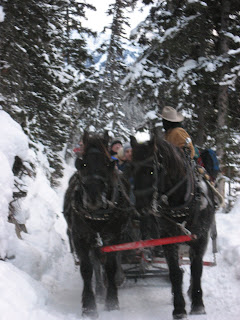

You bet I went on a sleigh ride! In the photo below you can see the hotel in the distance and make out some of the 113 ski runs that surround Lake Louise. 113! And snow. Lots of snow!


We rang in the New Year dancing our asses off all night at the Vegas themed gala to a great band. Everyone was up dancing. It was lovely to be in the company of so many families celebrating together, many from Scotland, Germany and England. And the food was divine!


Village Life
Since I am in a chatty mood, I would like to share some photos of my other home and family. I am a very lucky person to be able to go into work every day and be surrounded by such positive and nurturing people.
Since I am in a chatty mood, I would like to share some photos of my other home and family. I am a very lucky person to be able to go into work every day and be surrounded by such positive and nurturing people.
Two treasures in my life are Karen Dinner (left), owner of Village Yarns and Gloria Williams who teaches at the store.

Karen makes it all possible and with changes in the demands of her personal life she has given me creative freedom to merchandise the store. With all this glorious colour around, I never get depressed in the winter months working here. Karen and I have fun deciding on feature products and she is always on the hunt for new and interesting display items.
Pictured below is a sampling of hand dyed yarns from Fleece Artist & Hand Maiden hand dyed "Rumple" silk.

Prism Yarns from Ft. Lauderdale, Florida.

Alchemy Yarns of Transformation from California & Namasté Knitting Bags.

And a Bouvier des Flandres to gaurd the sock yarn.

In addition to retailing the finest hand knitting yarns, we are also known as a teaching store with many classes and workshops, including Project Groups...
 Finishing Classes...
 Crochet....
 And Vogueing....
  We also take time to compare notes and seek advice from one another regarding our own knitting projects. Rosa, pictured, and I are constantly schlepping 2-3 bags of knitting to work with us for show and tell. I love the comraderie, the sharing, the honesty that I get from these people.
 And we're most happy when there is cake!

Gloria Williams, our teacher extrordinaire, chatted me up one day about cake and what my Mother made for me on my birthday as a boy. I told her stories of chocolate cake iced with 7 Minute Frosting and decorated in special ways. This was months ago. Well, was I ever treated on my birthday this month! Gloria made the cake from scratch using the 7 Minute Frosting and then using red licorice cord, hand knit a licorice trim for the cake. Yes, we're crazy but we'd not have it any other way.

Take Care of yourselves.
Patrick Madden.
Toronto, Ontario CANADA


