All content ©Patrick Madden/Superba Knitting™. Please do not copy images, text and do not link to this site for use on any online private sale, auction or classified ad like eBay, Kijiji, Craigslist or eBay Classifieds. Other knitting and general interest blogs and websites are welcome to link to Superba Knitting for the purpose of information sharing. Thank you for respecting this ~ Patrick.

Sunday

Lace Weight Mohair & Lace Stitch Inspiration For SUPERBA, SINGER, PHILDAR and WHITE Brand Knitting Machines.


Welcome!


I love the feel and look of Lace Weight Mohair. 


I work with this yarn quality on a daily basis at my local yarn shop, as it is a popular quality of hand knitting yarn for garments and accessories.


Especially for patterns involving Lace Stitches, as it shows stitch definition very well and the resulting fabric is so light and airy.


Blocked & Unblocked Hand Transferred Lace Using Lace Weight Mohair.

Lace Weight Mohair is surprisingly strong, being spun with either a Nylon or Silk core. 


The colour range for Lace Weight Mohair is exceptional and it knits up so light and airy while being incredibly soft. This light weight contributes to the incredible yardage in each 25g ball. On average 225 yards! So a little goes a long way. 


This is not the harsh and scratchy Mohair of days gone by. Educate yourself as a consumer and go visit your local yarn shop if you have not visited one in a while. There have been and continue to be, great developments in the variety of yarns produced by major yarn mills around the world.


(Of course some people will never be able to wear or work with this long hair fibre due to the "fluff" factor which get's in their nasal passages or if they are hyper allergic to goat hair.)


One winter day back in January I was organizing the Mohair Yarn section at the yarn store and my thoughts turned to my niece Meghann who had recently given birth to a daughter. The idea came to me that I would knit her a Christening Gown as a present. 


I had a little girls Empire Waist Coat pattern already charted at home and I started imagining how this would look modified with a longer and fuller "skirt" section to make it look like a traditional baptismal garment worn by babies.


In my mind, the colour would be white with pearl buttons and silk ribbon for accents and an intricate Lace Stitch technique. I imagined a lace stitch pattern that would provide visual interest and cause the hemline to scallop or form points. No simple eyelets and definitely not Feather & Fan! Too pedestrian. 


Maybe a Silk fabric for the bodice of the coat. The yarn would be Silk to match. Silk and - Mohair! Bingo! A perfect choice for what I had in mind and I was standing right in front of it. 


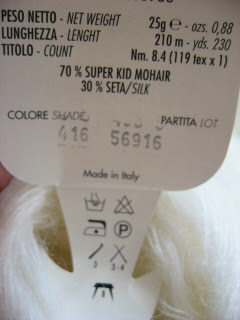
I had been wanting to knit something with this quality of mohair yarn on my Superba for ages but I hadn't known what...until now. With my yarn choice made I purchased a ball of Madil "Kid Seta", a beautiful blend of Kid Mohair and Silk and went home that night to review my knitting library for an appropriate Lace Stitch Pattern and begin swatching.


Lace Stitch Patterns.


As a knitting teacher I do my fair share of lace knitting at work but rarely do I knit complete garments in this technique. 


There are thousands of stitch patterns and techniques to choose from and only so many hours in the day, so one has to think carefully about what you will commit yourself to in terms of projects.


At the time I began knitting the Christening Gown on my Superba, I started this hand knit lace project from the Holiday 2006 issue of Vogue Knitting. 


I love Vogue Knitting. They always have great garment designs combined with gorgeous stitch techniques. 


The garment is the Tie Front Cardigan by knitwear designer and artist Shirley Paden, who is an extremely talented and technically brilliant knitter and pattern writer. 


I had been drooling over this Tie Front Cardigan pattern for months and finally succumbed to the temptation.

The Stitch pattern is called "Frosted Flowers" which comes from a Japanese hand knitting stitch pattern book and features a nice balance of paired decreases and eyelets.


Frost Flowers Lace Stitch 


This is an example of what I like in lace stitches. The knitting shown has not been blocked yet so the yarn overs or "eyelets" are not full open but you get the idea.


Notice with the Frosted Flowers stitch pattern that there are rows of purl stitches that run like ridges horizontally through the fabric. I love that in lace. I love how the paired decreases are clustered together and the eyelets are grouped together. I am not the biggest fan of all-over lace stitch patterns with lots of eyelets. My preference is for a stitch pattern that produces a more substantial fabric. 


So I went in search of one suitable for working on my Superba Knitting machine, with similar elements.


Japanese Stitch Patterns


Ribbon Knits is a Japanese Hand Knitting publication from the early 1980's, that I purchased on ebay a few years ago. I remembered that Ribbon Knits had many interesting lace stitches that might translate well on my Superba.


As far as the style of lace stitch pattern I was interested in, I knew that I wanted the structure of the stitch pattern to stand out. 


I wanted a stitch pattern with strong vertical and horizontal lines and lots of stitch transfers to make the fabric undulate. 


In Lace Knitting, if you line up your paired decreases and Yarn Overs row after row, the horizontal edges of the fabric automatically create scallops or chevrons, also referred to in english as a "Saw Tooth" edge. 


I did NOT want a soft, all-over design to the stitch pattern. No clusters of simple eyelets.


Knitting with this fine Mohair yarn, there would be enough drape happening as it was. Also, as I had chosen White to knit with I did not want to go to all the effort of transferring the stitches, only to have the pattern disappear against a white background. My memory served me well as I rediscovered this Chevron Lace Stitch used in Ribbon Knits.


Japanese knitting publications are a personal favourite of mine. Japanese knitting publications have the best layout and technical information for both hand and machine knitters, with beautiful stitch patterns and the best finishing techniques.


Translation: From Hand Knitting Instructions to the Machine


Knowledge of the Japanese language is not necessary to understand and use these stitch patterns as these publications use standardized knitting stitch symbols. They also provide excellent diagrams of how to perform the required techniques on a knitting machine.


Now don't be dismayed by looking at the Stitch Chart for the Chevron Lace pattern, which is below. I take you through the "How To" step by step in a series of seperate posts, beginning with How To Knit A Lace Weight Mohair Gauge Swatch: Part 1.


What I want you to do is to look at the structure of the stitch pattern as it is printed and see if you can identify what it was that first appealed to me about this particular stitch? Do you see it?


All the stitch symbols line up! They are continuously repeated, row after row vertically. 


Furthermore, the same pattern is repeated vertically as well as horizontally. To me this means that this will be easy to memorize and very easy to execute on my knitting machine, as I will be transferring the same group of stitches over and over.


This Chevron Stitch Pattern has a repeat of 14 + 3 stitches x 18 rows. The Gauge Swatch below shows how this translates into Lace Weight Mohair, which I knit on my Superba.


Why Transfer By Hand?


I am well aware that there are automatic lace transfer carriages produced by Japanese manufacturers including Silver Reed (brand names Singer, Studio, Knitmaster) and Brother (Jones, KnitKing). I have one. It won't work without crying tears of frustration every other row using Lace Weight Mohair, as the 4.5mm gauge or needle space is too fine for this kind of yarn. 


The hairs of the mohair yarn will catch on the sinker posts (even with waxing) and the transfers will not happen consistently.


Also, these transfer carriages are only available on the fine and ultra fine gauge machines. What does one do on a chunky or bulky knitting machine? 


More importantly: what if you want to introduce rows of contrasting purl stitches, cables or rib stitches to the lace fabric? 


You cannot do this style of Lace using an automatic Lace Transfer Carriage. 


©Superba Knitting™
You must do it by hand. And my preferred knitting machine for hand transferred Lace is a SUPERBA!


To achieve the style of lace stitch that I prefer, one would have to do multiple passes of an automatic lace carriage before knitting any actual rows anyway, so transferring by hand is just as fast to me. 


As I said, I hand knit. Everyday. Transferring stitches on a machine by hand is easy. Straightforward. Not time consuming at all. 


The advantage of doing this on a SUPERBA is the machine's ability to handle such a wide variety of yarn styles and fibers with ease.


You will find your Superba has the ability to handle a tricky fibre like Mohair with such finesse, due in part to a slightly larger needle gauge and the shape of the flow combs.


The ease of using the Transfer Carriage accessory to move large numbers of stitches back and forth between needle beds to create rows of contrasting purl stitches allows a SUPERBA to produce gorgeous stitch patterns that are usually only done by hand knitting.


The carriages on these machines are so light and easy to move back and forth that all this movement does not turn into a strenuous workout.


We can quickly lower and raise the Front Bed to check on our work and repair any stitches that do happen to drop off the needles.


The end result of all this work is a gorgeous, gossamer fabric with a delightful soft feel and wonderful stitch definition.


So don't be intimidated by yarns and techniques that you may think would not be possible to do on a standard gauge machine. 


Your Superba Double Bed Knitting Machine will surprise you!


I encourage you to visit and support your local yarn shop and to purchase a ball of either Madil Kid Set, Rowan Kid Silk Haze, Alchemy Haiku or Prism Gossamer lace weight mohair yarn and sample some lace stitches!


Take good care.
Patrick.

Baby It's Spring Outside! (2007)


Spring! Printemps! Bron!


Språng! ربيع Primavera! весна


Welcome friends from around the world! Welcome Spring and welcome back COLOUR!


Thank you to everyone who has signed on to the Frappr World Map. It's great to see who makes up this global community of ours. I hope those of you living in the Northern Hemisphere are enjoying the Spring season as much as I am. I trust you have been busy and creative.

Life for me always takes on a new level of energy and my daily routine shifts to accommodate the longer daylight hours as Spring takes hold.

It infuses all of the senses; the sound of birdsong, the smell fresh cut grass and rain, the feel of soil in your hands and the warm sun on your back. I always thank God for good vision as watching plants come to life, leaf and bloom is truly wonderful. The colours put forth are mesmerizing. Greens and Pinks are my favourites in flowering plants but just look at the intensity of the yellow in these blooms!


This love affair with colour is why I have such admiration and respect for yarn companies who specialize in hand dyeing their yarns, creating such marvelous, intense colourways with plant and animal fibres such as the following from Colinette of LLanfair, Wales and Blue Heron Yarn of Eastland, Maryland, USA.


Colinette Jitterbug Sock Yarn


Blue Heron Rayon Metallic, Beaded Cotton/Rayon and Rayon/Cotton Seed hand dyed yarns.


Blue Heron Yarns display at Village Yarns.


Close up of Blue Heron Cotton/Rayon Seed worked in Moss Stitch.


The wall of Sock Yarn at Village Yarns. Ahhh, choices! If you have never knit a pair of socks, either by hand or machine, give it a try. Your feet will love you for it. Cotton blended with Wool and Nylon are perfect for those of you with hot, itchy feet. Trust Mr. Size 13 here.


Lush Life.
Zoe loves laying in the lush, green grass in our back yard. She has favourite spots to lay and sleep throughout the day. When she chooses to go outside of course. I must admit the lawn is rather overgrown in comparison to our neighbours manicured lawn next door, but I did finally get part of it mowed yesterday. I'm not so uptight about having "the perfect" lawn anyways. I don't really understand the desire to have this patch of green that you won't even walk on and any and all plants pushed backed to the perimeter. Not for me. I am in the process of converting the entire back yard to one huge garden. Of course that takes time and money to do so but in 10 years or so it should be complete. There is plenty of time. I enjoy the transformation and the process.


Zoe is a Bouvier des Flandres, which is a Belgian herding breed originally. I adopted Zoe when she was 3. Now 10 years old, she is slowing down dramatically but still energetic if there are cats, raccoons or squirrels involved. As a breed, Bouviers typically have very thick, coarse curly outer hair and a fine, dense undercoat. This requires constant brushing or they mat badly. 


In the spring I always have Zoe shaved very short to keep her cool and clean. Well, to a dog this is a shaming process and for two weeks I had a very depressed dog on my hands. If you have a long hair breed of dog you will understand what I just went through. It is only in the past week where she has come out of her shell and is her engaging, affectionate self. She looks very awkward initially, but as her hair grows in she evens out. I will keep trimming her until September and then she will have 8 months to grow her coat out again.


On The Needles:
Pictured is Prism Yarn "Cool Stuff" (yarn on far right), a hand dyed yarn featuring an outrageous combination of over 50 yarns in one ball, all colour coordinated in various textures. The colour is "Rio Fantasy". I have combined it with Colinette "Parisienne" lace weight Kid Mohair. I am trying to keep things simple by alternating the yarns every two rows with Garter Stitch in a Short Row technique. This way you get to see all the textures and colours that are components of the "Stuff" yarn.


If you have never knit with Prism Yarns (www.prismyarn.com) I suggest you give them a try. Prism has an outstanding and very sophisticated colour range and the quality of the yarns are second to none. I have waited a long time to work with Prism "Stuff" as it retails for $69/skein Canadian and is therefore on the "precious" side shall we say. The amount of work and thought that the company puts into their "Stuff" line of yarns is incredible. I have tried to replicate this yarn for customers by combining various other yarns in our store and it just doesn't work nor does it come close to the product they produce. For one customer who was trying to match a certain colourway of Prism she had at home, I got up to 22 different yarns which were well over $200 in price and no where close to what their yarns consists of.


Laura Militzer Bryant is Creative Director for Prism Yarns and an award winning artist with an outstanding colour sense. This is definitely reflected in the yarns her company produces. I am thrilled to be taking a workshop hosted by Laura at The National Needle Arts trade show in Columbus, Ohio at the end of May. TNNA is the largest needle arts trade show in North America. I have been invited by Karen Dinner of Village Yarns to attend the show and participate in their "New Buyer" programme. I will definitely report back to you on what I see.


A big Thank You! to those of you who wrote with kind words about my "Mohair Love Affair" in my last post. I had hoped to have pictures to put up for this entry on blocking the piece I was knitting - but someone forgot to save the photos to his memory stick and doesn't have them on this computer. I will update you.


Upcoming Posts
How do I accomplish all this? I take photos as I work on my own projects. It's really that simple. If I think the processes and techniques I am using would be of use to someone then out comes the camera. The average number of photos I take per project or technique is between 300-500. Think about the number of steps involved and it adds up. Trust me. Then there is the editing, uploading and writing of the text and blah, blah, blah. I just get antsy because 3 months have gone by since I last posted anything new. But we can only accomplish so much in a day. Until I go live with video or learn a faster way to put these on the net, Blogger.com works just fine. Slow but good.


Two topics I have been working very hard on are meant to be companions to the Basic Instruction Book. These will hopefully assist knitters with learning the Principle Parts of their machine and how to operate their Superba knitting machine, maximizing all the wonderful features. I will be dividing this into two parts, focusing on the following:


Superba Principal Parts: The Double Bed Knitting Machine


Superba Principal Parts: The Carriage


Basic Cast On Techniques


Garter Transfer Lace Carriage Basics


Superba FORMA Pattern Driver:


Basic Circular Socks:


Sock Toe and Heel Variations:


The 16 x 16 Grid Programmer:


Double Bed Stitch Techniques:


Japanese Stitch Symbols & Patterns:


New Arrival


I received my Superba System 624 Selection Box from England recently. Now all I have to do is wait for the knitting machine to arrive and I can start using it! I bought this on Ebay to have as a back up unit. Remember, these machines are not made anymore and parts are very scarce, so it's wise if you're serious about knitting to have spares. I'll do a complete post on this model when the machine arrives. Here's a peek at what the Selection Box looks like.


The Superba System 624 Selection Box has over 100 programmed stitch patterns stored in its memory. Using the function keys you can manipulate the length and width to achieve large stitch repeats.


On the back of the box is the memory cartridge, which according to the manual can be removed and other pattern cartridges can be inserted. I've never seen any information regarding other memory cartridges but now I will be on the hunt for them.


The System 624 Selection Box comes with a plastic sleeve which slips over the box for programming your own designs.


You can program stitch patterns up to a maximum of 24 stitches wide and 60 rows long.


The programming guide slips over the Selection Box itself, and then you slide your design sheet in through the guide. This helps align each row to be programmed. You enter a new pattern row by row, one stitch at a time just like on the 16 x 16 pressure pad models.


For comparison, here are three of the five Selection Boxes produced by S.I.T. Group Superba ®. Left to right: the 16 Stitch Programmer, System 624 Selection Box, and the Light Scanning 60 Stitch Selection Box.


The 624 Selection Box in Front of my White 1502 for size comparison.


Friends Called Family
My siblings and I gathered in London, Ontario at my sister Barbara's to celebrate Mother's Day with our mother Genevieve. I am my mothers tenth child and while not every brother and sister were able to attend, six of her ten children, plus grandchildren and great grandchildren enjoyed a fabulous Spring day to honour this grand lady.


Pictured below are four generations of my family. My mother Genevieve on the right, my sister Susan in the middle, granddaughter Meghann on the left holding great granddaughter Maya. Priceless.


This was my first opportunity to meet Maya and she is adorable.


My sister Barbara is a wonderful hostess and a fabulous cook. The menu was Grilled Beef Tenderloin with a Shrimp & Scallop Hollandaise sauce, Grilled Sweet peppers with melted Goat Cheese, Asparagus, Potato Salad and Strawberry/Blueberry Spinach Salad. Dessert was an assortment of fresh pies baked by my mother and Chocolate Fondue with fresh fruit. Lot's of Belgian beer - love Chimay! - and assorted wine made for a fine feast.


Barbara's son Jacob took over as the Grill Master.


Being such a gorgeous day what could be better than a game of Bocce. Canadese style of course.


The women kicked ass of course!


My sister Genevieve with Maya.


My brothers Robert and Michael.


Yours truly pictured with my mother Genevieve and brother Robert. I got all the height genes in the family!


Our grand nephew Avery, happy to be catching pollywogs in the pond.


My niece Meghann and her husband Derek.


My sister Susan, her grandson Avery and daughter Meghann.


Pretty baby!

Susan with grandson Avery.


A very happy Uncle.


There are no friends like Family. God Bless. Patrick Madden.
Toronto, Ontario CANADA
superbaknitting@gmail.com